

Disclosure: I'm a developer who works with React, Next.js, and AI agents, and I offer SEO and content services, so I have a business interest in this topic. AI tools helped with research and drafting; I reviewed the article before publishing. All figures come from third-party reports as of October 2026 and may change.
A drop in ChatGPT referral traffic in Google Analytics 4 (GA4) does not always mean you have lost visitors. Missing UTM parameters or referrer information can cause ChatGPT visits to appear as (direct) / (none) instead of referral traffic.
If you noticed a decline around October 8–9, 2026, compare ChatGPT and Direct sessions for the same landing pages before and after those dates. If ChatGPT sessions decrease while Direct sessions increase, attribution issues may explain the change.
For developers, checking campaign parameters, referrer data, redirects, and GA4 tracking helps distinguish measurement problems from genuine traffic declines.
Key Highlight
- Traffic shift: Adobe reported 31,000 fewer daily ChatGPT visits and 26,000 more Direct visits across roughly 500 pages.
- Page-level impact: Two-thirds of pages losing ChatGPT traffic saw Direct traffic increase.
- Bug timeline: OpenAI reportedly acknowledged the bug on October 14, with tagged clicks returning on October 15.
- Tracking signal: UTM parameters remain important because referrer data is often missing.
- Target audience: Developers, SEO professionals, and analysts tracking AI referral traffic.
What the ChatGPT UTM Bug Actually Did
Google Analytics 4 (GA4) uses URL tracking parameters and referrer information to identify where website visitors come from. If both signals are missing, GA4 may classify ChatGPT visits as (direct) / (none) instead of ChatGPT referrals.
According to Cedric Huesler's analysis, GPT-6 may have removed the utm_source=chatgpt.com tag and referrer information when opening links. However, I haven't independently verified this mechanism, and OpenAI has not published a detailed technical explanation.
Key Events
- October 7–8: GPT-6 rollout reportedly began.
- October 9–11: LLM Pulse reported a roughly 46% drop in ChatGPT referrals across its monitored websites.
- October 14–15: Huesler reported that OpenAI acknowledged the bug and tagged clicks recovered to around 95–100% of the previous week's level in Adobe's data.
These findings are based on reported analyses, not independent verification. OpenAI's release notes do not provide a detailed explanation of the issue.
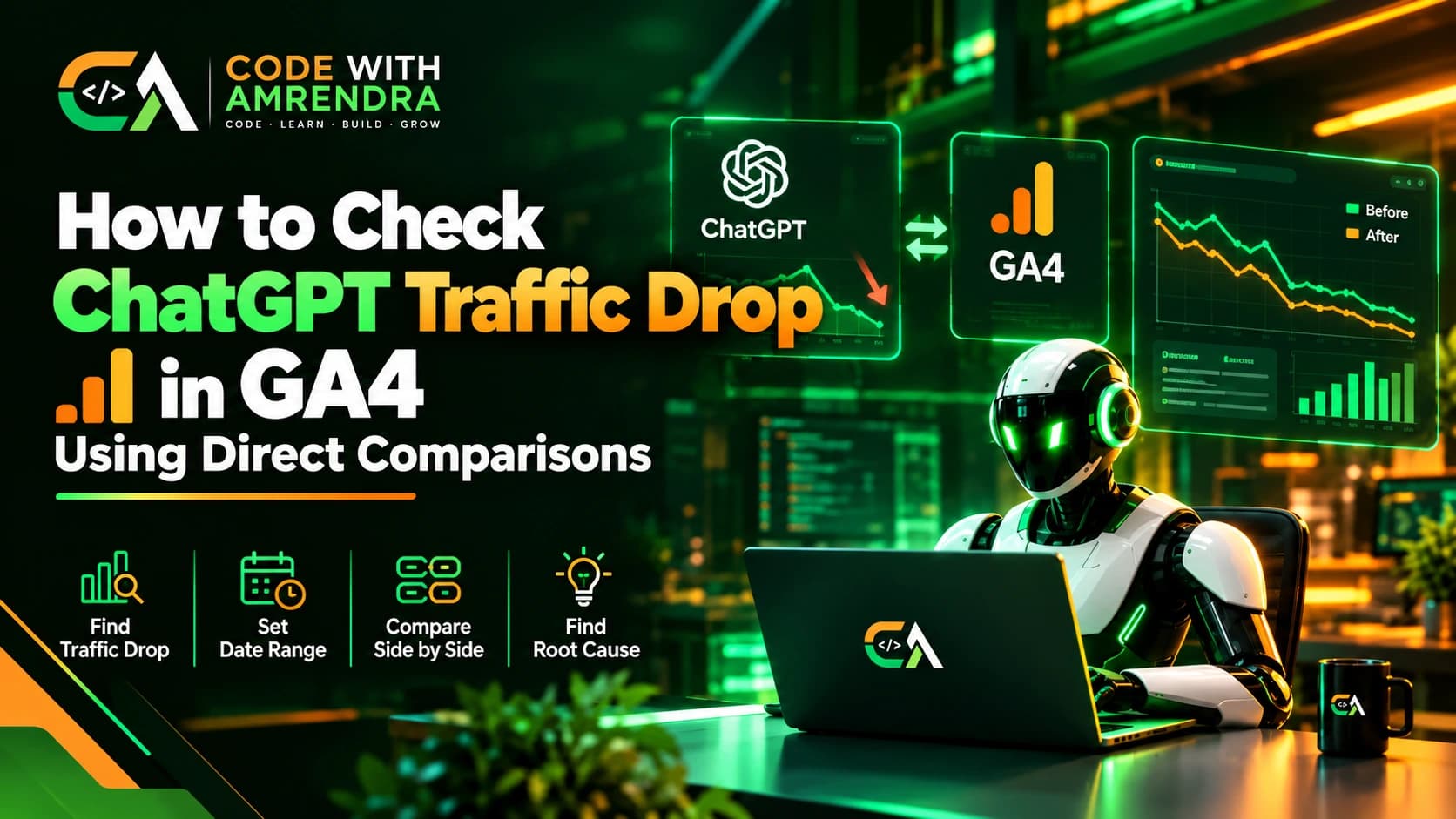
How to Check a ChatGPT Traffic Drop in GA4: 5 Steps for Developers
If your ChatGPT referral traffic dropped suddenly, don't assume you lost visitors. Use these five checks in Google Analytics 4 (GA4) to find out whether the traffic was reclassified as Direct.
Step 1: Compare Three Date Ranges
Start with three equal seven-day windows:
- Before: October 1–7, 2026
- During: October 9–15, 2026
- After: October 16–22, 2026
This comparison helps you identify when traffic changed and whether it recovered.
Step 2: Identify Your ChatGPT Landing Pages
In GA4, open Reports → Acquisition → Traffic acquisition. Select Session source / medium and find chatgpt.com. Add Landing page as a secondary dimension, then export your top landing pages.
Use these URLs as your test pages.
Step 3: Compare ChatGPT and Direct Sessions
Check (direct) / (none) sessions for the same landing pages across all three periods.
If ChatGPT sessions fall while Direct sessions rise on those pages, it may indicate an attribution issue. Check individual blog posts and deep URLs, not just your homepage.
Step 4: Compare Visitor Behaviour
Compare engagement rate, new-user share, and conversions between ChatGPT and Direct sessions. Similar behavior may support the relabeling theory, but it cannot confirm the cause on its own.
Step 5: Annotate the Reporting Period
Mark October 8–15 as a period to investigate in your reporting notes. Report ChatGPT and Direct traffic together for affected landing pages until you understand the change.
Developer takeaway: Compare the same landing pages across equal date ranges. A drop in ChatGPT referrals combined with a rise in Direct traffic is a useful clue, but not definitive proof of a tracking bug.
Need Help Auditing Your AI Traffic?
Unsure whether your ChatGPT referral traffic has actually declined or is being misclassified in GA4? I can help you review your traffic sources, landing pages, and technical SEO reporting to identify potential tracking issues.
Contact Code with Amrendra to discuss your website's SEO and analytics needs.
Real Drop or Tracking Bug? A Quick Comparison
A drop in ChatGPT referrals doesn't always mean fewer visitors. If ChatGPT sessions decrease while Direct sessions increase on the same landing pages, it may indicate a tracking issue rather than lost traffic.
Compare session trends, landing pages, and visitor behaviour in GA4 before deciding whether your website has lost traffic or attribution data.
| Signal in GA4 | Points to tracking bug | Points to real traffic loss |
|---|---|---|
| ChatGPT sessions | Fall sharply from ~9 Oct | Decline began before 7 Oct |
| Direct on same landing pages | Rises on those pages | Flat or falling |
| Total sessions | Roughly flat | Falls |
| Other AI sources (Perplexity, Claude) | Steady | Also falling |
| New Direct visitors | Behave like ChatGPT visitors | Behave like returning users |
| Recovery after 15 Oct | Tagged sessions return | Stays low |
LLM Pulse reported total traffic stayed flat and Perplexity and Claude referrals held steady in its data. That's the pattern in the middle column.
Hidden Costs, Mistakes and Red Flags
Before changing your SEO strategy, verify your GA4 data carefully. Traffic estimates may not match exactly, Direct traffic may not always increase, and missing attribution cannot reliably be recovered for past sessions.
- Don't treat estimates as exact: Huesler reported 31,000 fewer daily ChatGPT visits and 26,000 more Direct visits. The difference is unexplained, so avoid promising clients exact recovery numbers.
- Don't assume Direct traffic always increases: LLM Pulse did not observe the same pattern in its data. Your website may show different results.
- Understand GA4 channel grouping: Without a recognized referrer or suitable campaign parameters, GA4 may classify visits as Direct instead of AI referral traffic.
- Don't expect to recover missing attribution: These comparisons can help identify a possible tracking issue, but they cannot reliably reclassify historical sessions.
Conclusion
A sudden drop in ChatGPT traffic in Google Analytics 4 (GA4) doesn't always mean your website has lost visitors. Missing UTM parameters or referrer information can affect how GA4 identifies traffic sources.
Before changing your SEO strategy, compare ChatGPT and Direct sessions on the same landing pages across different date ranges. Review engagement, conversions, and traffic patterns to identify possible attribution issues.
My recommendation is to verify these changes using your own analytics data before reporting traffic losses to clients. Remember, a matching rise in Direct traffic is a useful clue, not definitive proof of a tracking bug.