
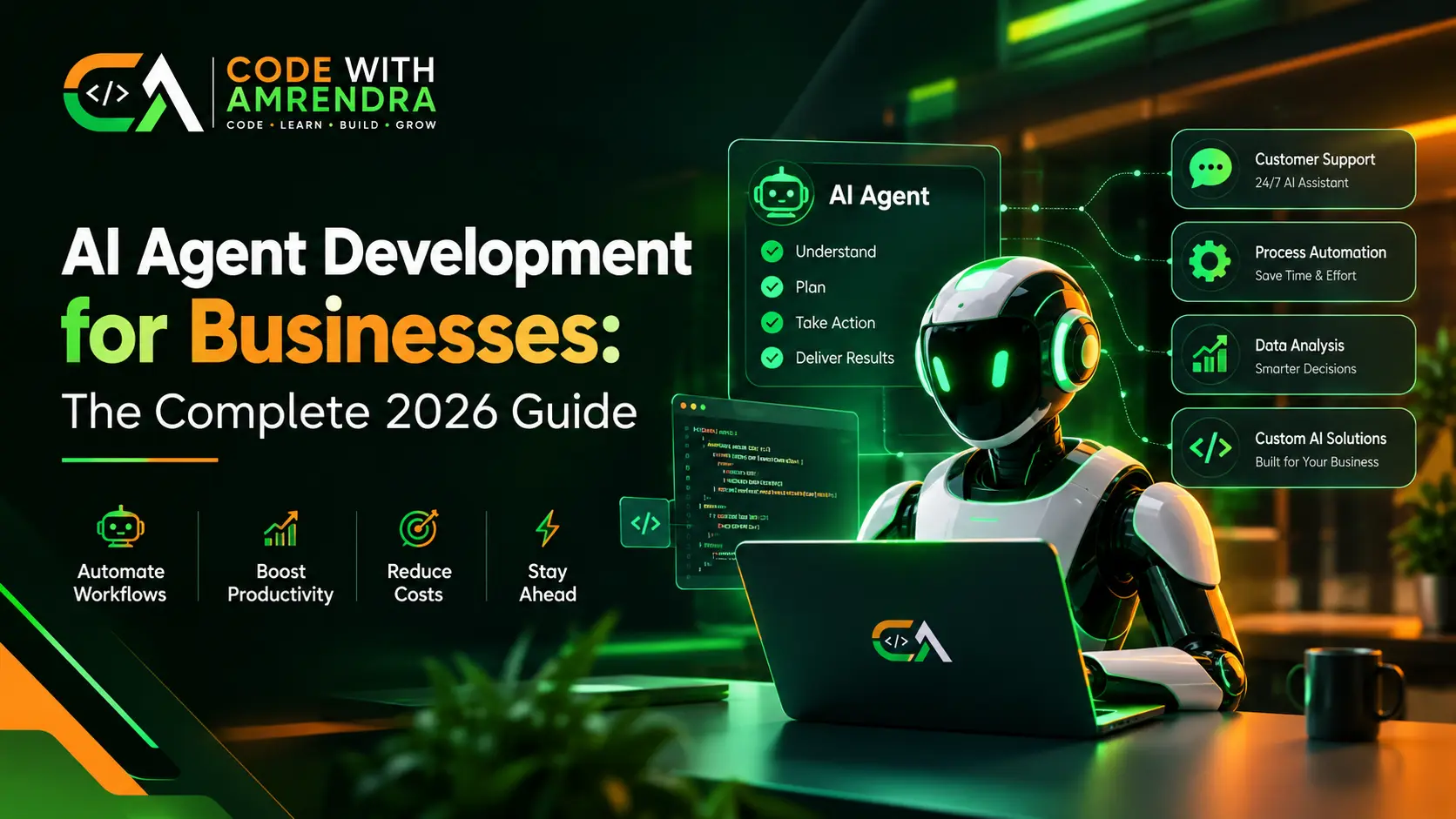
AI agents have moved from demo videos to real production systems. They now answer support tickets, qualify leads, and run internal workflows without a human clicking through every step.
If you're a founder or operations lead, you probably want to know what an AI agent actually costs, what it can realistically do, and who should build it. This guide walks through all of that in detail.
Quick Answer:
AI agent development typically costs 150,000+, depending on complexity, with simple single-task agents at the low end and multi-agent enterprise systems at the top.
Most small to mid-size businesses land between 50,000 for a production-ready agent, plus 1,500/month in hosting and API costs. You can see the full scope of what's included on our AI & Automation service page.
What Is an AI Agent, Really?
An AI agent is software that takes a goal, decides on the steps needed to reach it, and solves a multi-step problem with little to no human intervention. That's different from a chatbot, where most interactions are a single question-and-answer exchange.
Here are the main types worth knowing:
1. Rule-Based Agent
This follows fixed decision trees. It's cheap, predictable, and limited to the scenarios you've explicitly mapped out.
2. RAG (Retrieval-Augmented Generation) Agents
These pull from a stored knowledge base, product data, or documents before responding. They work well for support and internal Q&A. If you're evaluating one for your site, our RAG chatbot guide breaks down cost and setup in detail.
3. Autonomous Task Agent
This plans and executes multi-step actions on its own, updating CRM records or sending follow-ups based on a goal rather than a fixed script.
4. Multi-Agent System
Several specialized AI agents coordinate on one workflow. For example, one agent researches a lead while another drafts the outreach.
Most businesses don't need a multi-agent system on day one. A well-built RAG or task agent solves the real problem at the start, and that makes it easier to choose the right first project for a development partner.
How Much Does It Cost to Build an AI Agent in 2026
Knowing what an AI agent costs isn't hard once you know what you're comparing. Here's a quick breakdown of cost against what each type of agent actually does.
| Agent Complexity | What It Does | Typical Cost | Monthly Running Cost |
|---|---|---|---|
| Simple single-task agent | Answers FAQs from one knowledge source, no system writes | 20,000 | 400 |
| Workflow automation agent | Reads/writes to 1–2 tools (CRM, email, calendar) | 60,000 | 800 |
| Multi-system business agent | Coordinates across CRM, support desk, billing, and internal tools | 150,000 | 1,500 |
| Multi-agent enterprise system | Several agents, custom orchestration, compliance requirements | $150,000+ | $1,500+ |
These numbers track closely with what we quote for a RAG chatbot build. An AI agent is the natural next step once a business has a working RAG chatbot and wants it to act, not just answer.
If you want to keep costs predictable, scope a single well-defined agent as a first project. Most teams can ship one in 2–3 weeks, then expand its capability month over month with the same engineering team.
What ROI Actually Looks Like
The best way to judge an AI agent isn't by how impressive it looks, it's by how much time and effort it actually saves. Here's what that looks like in practice:
Saved hours per week: If an employee spends 20 hours a week on a repetitive task at an effective cost of ₹300 per hour, that's 20 × ₹300 = ₹6,000 saved per week, or roughly ₹24,000 worth of employee time saved per month.
Faster response time: A customer or lead who previously waited 3 hours for a reply can now hear back in about a minute after an AI agent is in place. That immediate response improves engagement and lowers the chance they move to a competitor.
Conversion lift: Leads that are qualified and reached faster tend to convert better. Our ShopEase case study showed a 41% conversion lift from faster, more targeted user flows, and the same speed principle applies to agent-assisted lead response.
Error rate: For repetitive data entry tasks, agents typically handle the work more consistently than manual entry once they're properly tuned.
A reasonable target: a well-scoped agent should pay back its build cost within 6–12 months through time saved or leads captured, not "eventually."
How We Build AI Agents in 2026
Building an AI agent isn't just about connecting a model to a few tools. A reliable agent needs a clear purpose, proper testing, and the right safety controls. That's why we follow a simple four-step process for every business we build one for.
1. Discovery & Architecture
The first step is clarifying the existing business process. We decide what the AI agent has to do, what it needs access to, and what it should never do on its own. This keeps full control in your hands and avoids unwanted actions.
2. Build in Fast Sprints
Instead of building everything upfront and revealing it at the end, we work in iterative weekly sprints. You see the agent working on real or realistic data early on, so you know what's going well, what issues have come up, and what needs improving before it reaches production.
3. Testing & Quality Checks
AI agents can make wrong decisions with total confidence, which is why testing is such a large part of our process. We test for unusual inputs, failures, miscommunication, and more. The goal is that when the agent isn't fully certain, it asks for help instead of acting alone.
4. Cloud Deployment & Monitoring
Once the agent is ready, we deploy it to production and start monitoring it. That lets us track errors and performance in the real system the agent runs in, so if something breaks, we can diagnose and fix it before it affects your customers.
If you want to learn more about the process, check out our AI & Automation service page.
Hidden Costs and Red Flags to Watch For
Building an AI agent can be genuinely valuable, but not every AI solution is built the same way. Here's what to check before choosing a vendor.
1. A Chatbot Being Sold as an AI Agent
Some vendors call a basic chatbot an "AI agent." Ask what it can do, not just what it can answer. A real AI agent should be able to complete work, use tools, make decisions within set boundaries, and carry out a task or series of tasks.
2. Ignoring API and Usage Costs
Building the agent is only part of the equation. Most AI models bill by usage, so your monthly bill can climb as you scale and your user base grows. Get clear with your vendor on what's a one-time cost (development) and what's recurring (APIs).
3. No Source Code or Data Ownership
Ask what happens to your code, prompts, workflows, and business data after the project wraps up. If everything lives on the vendor's platform, switching providers later can get complicated and expensive. Confirm ownership before signing anything.
4. No Plan for AI Mistakes
Ask your vendor what happens when the agent gets something wrong. Is there a fallback to a human, a confidence threshold that pauses risky actions, or a rollback process? A vendor with no answer here is a red flag, because agents that touch real customers or real money will eventually make a mistake.
5. Fixed Pricing With Unlimited Scope
AI projects often change once the team gets hands-on with real business data. New requirements, edge cases, or integrations can surface mid-project. A fixed lump-sum price with vague scope is hard to negotiate later. A milestone- or sprint-based approach is usually easier for everyone, since you can track progress and risk as you go.
Common Business Use Cases
AI agents help businesses automate repetitive tasks, respond faster, and cut down manual work. Some of the most common use cases include:
- Customer Support: AI agents can answer customer questions using your company's documents, FAQs, and help center, and hand off complex issues to a human when needed.
- Lead Qualification: An agent can read new leads from your website, gather useful information, identify strong prospects, and route qualified leads straight to your sales team.
- Internal Operations: Agents can handle everyday tasks like updating project trackers, summarizing meeting notes, creating action items, and flagging unusual changes in reports.
- Replacing SaaS Tools: Businesses are increasingly using AI agents for tasks that used to require a separate SaaS tool or paid seat. Instead of paying for software that handles one task, an agent can automate that task as part of a larger workflow.
Conclusion
AI agents aren't a future idea anymore; they're a practical way to cut response time, reduce repetitive work, and free up your team for higher-value work, as long as you scope the agent to a specific pain point rather than a vague "let's add AI" initiative.
The companies getting the best return on agents in 2026 focused on one well-defined process, budgeted for the total cost of ownership rather than just the initial build. They worked with a vendor that hands over full source code and data ownership.
If you've made it this far, you already know more about agent costs, build-vs-buy tradeoffs, and warning signs than most vendors will volunteer. The next step is turning that into a scoped plan for your business.
Build Your AI Agent With Code with Amrendra
Code with Amrendra designs and ships custom AI agents, RAG chatbots, and workflow automations for businesses that want production-ready results, not a demo that breaks the moment real data hits it. Every build includes full source-code ownership, weekly sprint demos, and AI-assisted QA before launch.
New to AI agents? Explore the full AI & Automation service to see the stack, process, and what's included.
Have a specific workflow in mind? Start a free consultation and get a real cost estimate for your use case, not a generic quote.
Need the agent connected to a broader product or website? Pair it with our Web Development or Cloud & DevOps services for end-to-end delivery.