

Why AI Agents Are Replacing SaaS Seats in 2026
AI agents replacing SaaS seats refers to the monumental paradigm shift wherein software applications that previously charged customers per person or seat are superseded by autonomous, goal-driven agents executing tasks on behalf of the user.
According to Gartner’s forecast, 35% of point-product SaaS tools will be consumed within an agent economy by 2030. The most affected processes are those that are repetitive or have a defined set of rules—including tier-1 helpdesks, data entry, CRM enrichment, and automated reporting. Meanwhile, core infrastructure and system-of-record processes survive.
Per-seat pricing historically assumed that headcount equals usage. That equation fundamentally breaks the moment a single autonomous agent finishes the work of ten logins. This article explores which categories are exposed first, a practical build-vs-buy framework, and the critical migration costs teams routinely underprice. For more deep dives, explore our guides on AI agent workflows.
What "AI Agents Replacing SaaS Seats" Actually Means
An AI agent does not log into a web dashboard to click buttons. Instead:
- It receives a high-level goal.
- It orchestrates and executes across the necessary tools and APIs.
- It validates and delivers the final outcome directly to the user or downstream service.
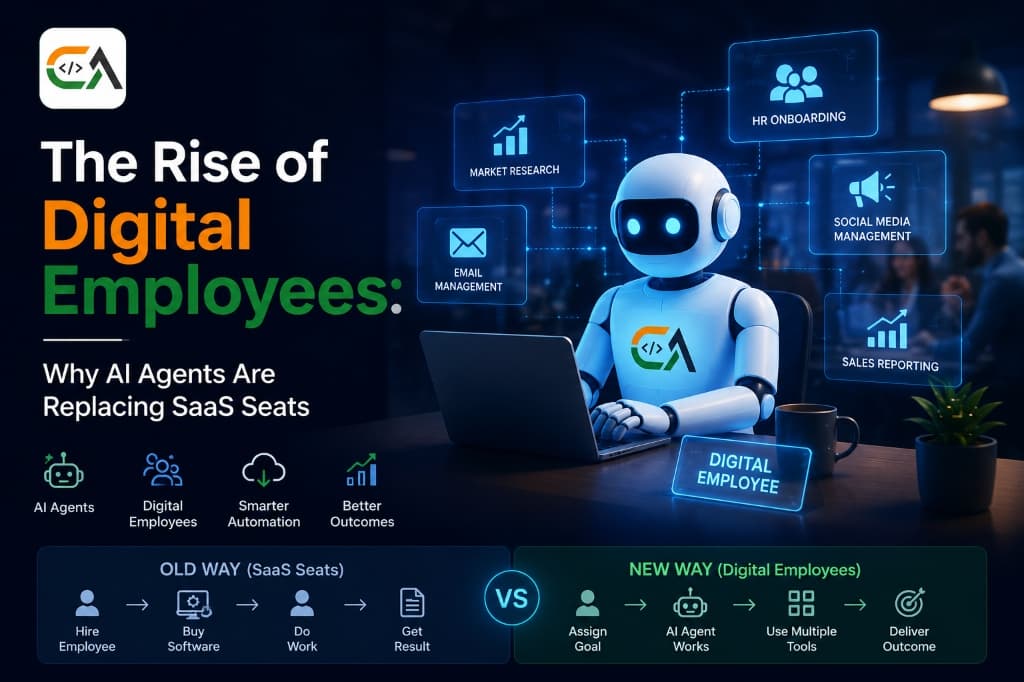
OLD WAY (SaaS Seats):
Hire Employee ──> Buy Software Seat ──> Manual UI Work ──> Output

NEW WAY (Digital Employees / Agents):
Assign Goal ──> AI Agent Works ──> Executes Multiple Tools/APIs ──> Verified Outcome
Because traditional SaaS pricing was designed around one seat, one login, and one headcount, replacing the manual operator with an autonomous agent eliminates the necessity of the individual seat license.
The effect compounds rapidly across an organization's tech stack. For instance, an SDR replaced by an agent workflow does not merely eliminate a single CRM license—it also removes the dialer subscription, the email sequencing seat, and the analytics login previously tied to that headcount.
Which SaaS Categories Break First
Tools built around a single, well-defined, high-frequency task are the most vulnerable. Conversely, tools governed by strict compliance mandates or serving as systems of record remain the most resilient.
| Workflow Type | Replacement Risk | Example Exposure |
|---|---|---|
| Tier-1 Customer Support | High | Ticket routing, triage, and end-to-end FAQ resolution automated autonomously |
| CRM Data Entry / Enrichment | High | Agents scrape, verify, and populate customer records without a human seat |
| Weekly Reporting / Dashboards | High | Agents pull API metrics, compile summaries, and distribute reports directly |
| Sales Outreach Sequencing | Medium | Agents draft and send personalized copy; final negotiation and strategy stay human |
| System of Record (DB, Identity, Cloud) | Low | Agents run on top of these foundations—they do not replace them |
Source: Deloitte TMT Predictions 2026, AWS ISV Insights. Last updated: August 2026.
The Build-vs-Buy Decision Framework
Before cutting a SaaS seat or building an internal agent, evaluate the target workflow against three core criteria:
- Frequency & Volume: Daily or weekly volume justifies agent engineering costs. Infrequent or one-off tasks rarely justify custom automation.
- Rule-Based vs. Judgment-Based: Agents excel at repeatable logic and deterministic tool calls. Complex negotiations, legal determinations, or nuanced brand tone still mandate human-in-the-loop oversight.
- Integration Surface Area: Automating a task spanning five disparate third-party APIs costs significantly more to maintain reliably than an agent operating across one or two robust endpoints.
Salesforce’s shift toward consumption-based "Flex Credits" in Agentforce reflects this market reality: billing is migrating toward work performed, rather than how many humans are logged in.
The Hidden Migration Cost Nobody Prices In
Cutting a per-seat tool is never friction-free. Data export pipelines, schema normalization, record migration, and compliance mapping demand substantial engineering hours that rarely appear in the headline "we saved $80,000 on software licenses."
In production migrations, the underpriced cost is almost never the agent construction itself—it is untangling and preserving the audit trails and compliance logs that the legacy SaaS application managed out of the box. Teams must budget dedicated migration time separately from core agent development.
Frequently Asked Questions
1. Will AI agents completely replace SaaS?
No. Databases, identity providers, compliance layers, and core cloud infrastructure remain essential. Gartner projects that 35% of point-product tools will be absorbed into agent workflows by 2030, rather than a total replacement of the SaaS ecosystem.
2. What is the difference between AI agents and traditional automation?
Traditional automation (like Zapier or cron jobs) follows static, rigid if-then rules. In contrast, AI agents can dynamically reason through ambiguous goals, handle unexpected edge cases, and autonomously choose which tools and APIs to execute.
3. How is SaaS pricing changing because of AI agents?
Per-seat pricing models have dropped significantly across enterprise software vendors, rapidly being replaced by usage-based, consumption-based (credit/token), or outcome-based billing models.
4. What is a "Digital Employee" in AI?
A digital employee is an autonomous AI agent assigned continuous responsibility for a specific operational role (such as customer ticket resolution or invoice reconciliation) without requiring a human-operated software seat.
5. Which SaaS categories are most at risk from AI agents?
Tier-1 customer support, automated data entry/enrichment, and recurring report generation are the most vulnerable due to their high frequency and structured workflows.
6. Should SaaS vendors switch to outcome-based pricing?
Yes. SaaS vendors that automate their users' workflows while continuing to charge per human seat risk rapid revenue decay as customers downsize seat counts.
7. Is it cheaper to build an AI agent than buy a SaaS tool?
For narrow, high-volume, well-defined workflows with clean APIs, building an agent is often significantly more cost-effective. For workflows requiring dozens of complex third-party connectors and regulatory certifications, commercial software still wins on reliability.
8. What is the "SaaSpocalypse"?
A term describing the revenue decline experienced by traditional software vendors as autonomous AI agents reduce the number of human logins and seat licenses required by enterprise customers.
Conclusion
AI agents and digital employees are fundamentally reshaping software economics. The tools that endure will be the platforms on which agents are built and orchestrated, rather than the point-solutions that agents replace. Audit your organization's software stack by usage frequency and rule dependency before your next renewal cycle.
To learn more about implementing agentic workflows and full-stack software architecture, explore our Web Development Services and subscribe to the Code with Amrendra engineering updates.