

Quick Answer
A rag chatbot for business typically costs 80,000 to build in 2026, with 2,000/month in ongoing hosting and API costs. Simple single-source bots sit at the low end; multi-system, CRM-connected bots push toward $150,000+.
What Is a RAG Chatbot, Really?
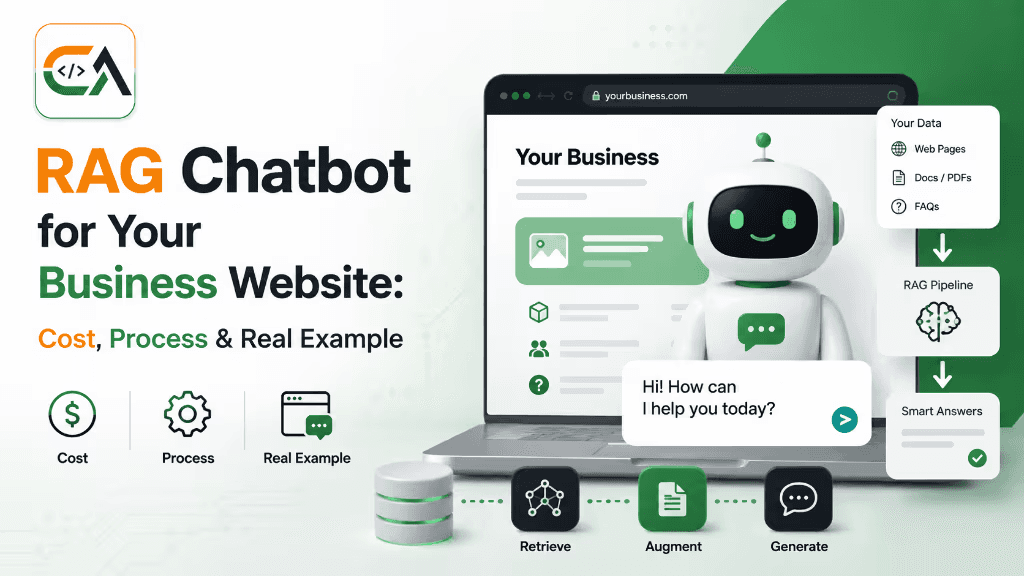
RAG stands for Retrieval-Augmented Generation. Instead of a chatbot guessing answers from what it learned during training, it first retrieves relevant chunks from your own documents — product manuals, FAQs, policies, and help articles — then hands those chunks to an LLM (like GPT-4o or Claude) to write the final answer.
This is important because a basic LLM chatbot would confidently make up information about your refund policy or price tiers. A RAG chatbot allows you to pull from your own information to answer questions. Hence, as your business grows and changes, your chatbot will always give you accurate information without having to retrain the model.
RAG Chatbot Cost Breakdown (2026)
Real 2026 market pricing, pulled from agency quotes and dev studio breakdowns:
| Chatbot Tier | Build Cost | Monthly Run Cost | Estimated Timeline |
|---|---|---|---|
| Basic RAG (1 data source, FAQ-level) | 30,000 | 1,000 | 4–6 weeks |
| Mid-complexity RAG (multi-source, CRM tie-in) | 80,000 | 5,000 | 8–12 weeks |
| Enterprise RAG (multi-agent, compliance, permissions) | 250,000+ | 15,000 | 3–6 months |
For context on where these numbers come from: a basic FAQ-level RAG bot using an API like OpenAI's or Claude's typically starts around 75,000 and $120,000 with 8–14 weeks of development.
What actually drives the price up:
- Number of data sources you're connecting: (one PDF vs. your entire Notion + CRM + ticketing system)
- Vector database choice: Pinecone's standard tier starts around $50/month, but usage scales with document volume
- Role-based permissions: (so the bot doesn't leak internal docs to public users)
- LLM API costs per resolution: usually 6 depending on model and conversation length
- Integration depth: with your existing CRM, helpdesk, or booking system
For a small business site, you don't need the enterprise tier. Most codewithamrendra.in clients land comfortably in the basic-to-mid range, especially if the scope starts narrow.
RAG vs Rule-Based vs Fine-Tuned: Which One Do You Need?
| Comparison Metric | Rule-Based Chatbot | RAG Chatbot | Fine-Tuned LLM |
|---|---|---|---|
| Best for | 20–30 fixed Q&As | Answers from your live docs/data | Very specific tone/format, narrow domain |
| Setup cost | 15,000 | 80,000 | $50,000+ |
| Updates when content changes | Manual rebuild | Automatic (re-index docs) | Requires retraining |
| Handles unexpected questions | No | Yes, if source content covers it | Yes, but rigid |
| Time to launch | 1–2 weeks | 4–12 weeks | 2–4+ months |
For most business websites — service pages, product catalogs, support docs — RAG is the right call. Fine-tuning is overkill unless you have a very specific, measurable gap that good prompting and retrieval can't close.
The Build Process, Step by Step
- Content audit: List every source the bot should pull from — help docs, pricing pages, PDFs, and past support tickets. Messy or outdated content here means messy answers later.
- Chunking & embedding: Your content gets split into small chunks and converted into vector embeddings, stored in a vector database (Pinecone, Weaviate, or pgvector for a lighter setup).
- Retrieval pipeline: When a user asks a question, the system searches the vector database for the most relevant chunks — this is the "retrieval" half of RAG.
- LLM response generation: Those chunks get passed to the LLM along with the user's question, and it writes a grounded answer with the actual source context in front of it.
- Guardrails & testing: You set rules for what the bot won't answer (pricing negotiations, legal advice), and test it against real user questions before launch.
- Deploy & monitor: Embed it on the site, track resolution rate, and re-index content whenever your docs change.
A Real Example: Support Bot for a SaaS Product
A mid-sized SaaS company wanted a bot to cut first-response time on support tickets. Scope: one knowledge base (about 200 help articles), Zendesk integration, and a widget on their site.
- Data sources: Help center + product changelog
- Vector DB: pgvector (kept costs down vs. a managed service)
- LLM: Claude, chosen for accuracy on technical, multi-step answers
- Build time: 6 weeks
- Build cost: ~$28,000
- Monthly cost: ~$650 (hosting + API calls, roughly 1,500 resolutions/month)
- Result: deflected about 55% of tickets before they reached a human agent — in line with what even strong AI agents in the market resolve autonomously, since no chatbot hits 100% automation.
That 55% number matters — set expectations with your team before launch. A RAG chatbot reduces load; it doesn't replace support entirely.
If you're exploring how this fits into a bigger picture of automating business workflows, our team breaks that down further in AI & automation services and how AI agents are reshaping SaaS.
Hidden Costs & Mistakes to Avoid
- Vector DB costs creep up: They scale with document volume and query frequency — budget for growth, not just launch-day numbers.
- Maintenance isn't optional: Custom builds need roughly 15–20% of the initial build cost every year for updates, security patches, and re-indexing as content changes.
- Skipping the content audit: If your existing docs are outdated or contradictory, the bot will confidently repeat those mistakes. Clean the source first.
- No fallback for "I don't know": A bot that always answers, even when it shouldn't, erodes trust fast. Build in an honest "let me connect you to a human" path.
- Ignoring permissions: If the bot pulls from internal + public docs without access control, it can leak information it shouldn't.
FAQ
How much does a RAG chatbot cost for a small business website?
Most small business RAG chatbots cost 30,000 to build, with 1,000/month in running costs, assuming a single data source and standard integrations.
Is RAG cheaper than fine-tuning an AI model?
Yes, usually significantly — RAG avoids the cost and time of retraining a model, and most businesses that think they need fine-tuning actually just need RAG done well.
How long does it take to build a RAG chatbot?
A basic version takes 4–6 weeks. Mid-complexity builds with CRM or helpdesk integration typically take 8–12 weeks.
What's the difference between a RAG chatbot and a regular AI chatbot?
A regular LLM chatbot answers from what it learned in training and can hallucinate facts about your business. A RAG chatbot retrieves from your actual documents first, so answers stay grounded and current.
Can a RAG chatbot fully replace customer support?
No. Even top-performing AI agents resolve roughly half to two-thirds of conversations autonomously — a RAG chatbot reduces support load; it doesn't eliminate the need for a human team.
What vector database should I use for a RAG chatbot?
Pinecone is a common managed choice starting around $50/month. For smaller budgets, pgvector (built on Postgres) is a solid lighter-weight option.
Do I need a developer to maintain a RAG chatbot after launch?
Yes, budget for ongoing maintenance — roughly 15–20% of the build cost annually — to re-index content, patch security, and tune accuracy as your business changes.
Conclusion
A RAG chatbot is worth building when you have real content to ground it in help docs, FAQs, product info, and a clear job for it to do, like cutting first-response time on support tickets. For most business websites, that means budgeting 80,000 for the build and 5,000/month to keep it running, depending on how many data sources and integrations you need.
Skip the enterprise tier unless you actually have enterprise complexity. Start with one data source, one clear use case, and an honest fallback to a human when the bot doesn't know the answer. Expand from there once you see real resolution numbers, not projected ones.
Written by Amrendra — Frontend Developer & Technical Content Writer, working hands-on with React and Next.js projects.
Thinking about a RAG chatbot for your own site? Get in touch, and we'll scope it based on your actual content and budget — not a generic quote.