

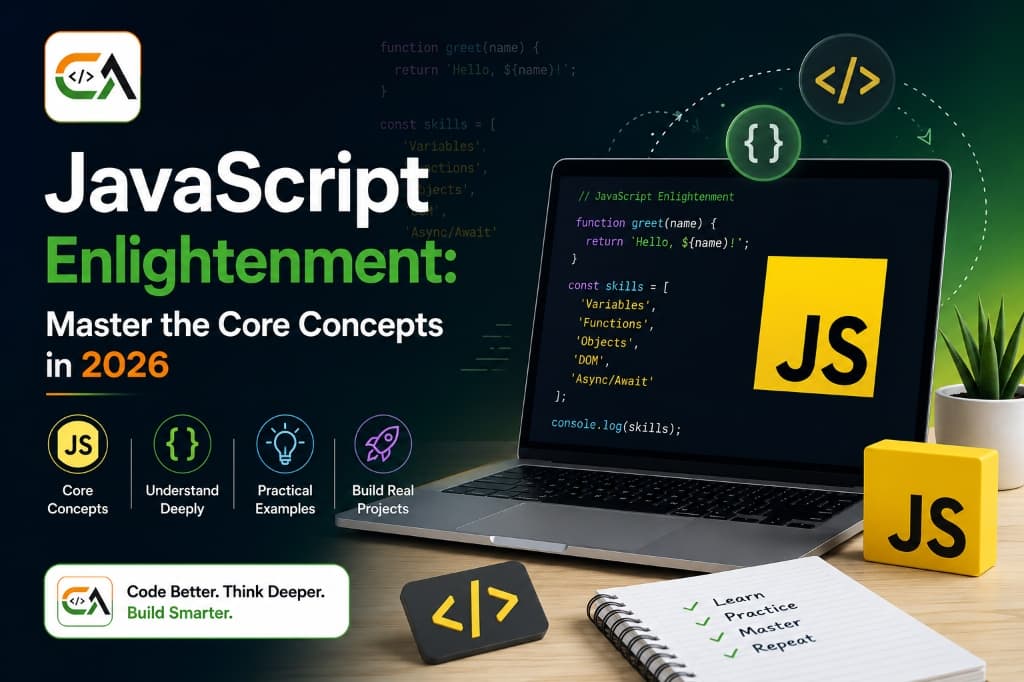
JavaScript Enlightenment: Master the Core Concepts in 2026
Quick Answer
JavaScript Enlightenment means you understand how the language actually works: scope, closures, prototypes, this, and the event loop, instead of only knowing how to use a framework on top of it. In 2026, this matters more than ever because AI tools generate JS code fast, but only developers with strong fundamentals can debug it, review it, and know when it's wrong.
What "JavaScript Enlightenment" Actually Means
The term comes from a well-known O'Reilly book by Cody Lindley, written to help developers move from "library user" to "JavaScript developer." The idea is simple: most people learn JavaScript through jQuery, React, or Next.js first, and the language itself second, if at all.
That order works fine until something breaks. A state update that doesn't trigger a re-render. A this value that's suddenly undefined. A closure that quietly leaks memory in a long-running app. These bugs don't show up in framework documentation. They live in the language underneath it.
Getting "enlightened" means you can explain why your code behaves the way it does, not just how to make it work by trial and error.
Why Fundamentals Matter More in the AI-Coding Era
In 2026, a lot of javascript future gets written by AI assistants first and reviewed by a human second. That flips the skill that matters most. You used to need to write code fast. Now you need to read code fast and catch what's wrong with it.
If you don't understand the event loop, you won't notice that a Promise callback runs before a setTimeout(fn, 0). That detail causes real race conditions in production. If you don't understand prototypes, an AI-suggested class hierarchy can look correct and still behave oddly under the hood. Fundamentals are what let you say "wait, that's not right" before a bug ships.
This is also why interview processes at both startups and larger companies still lean on closures, scope, and the event loop. They're a fast way to check if a candidate understands the engine, not just the steering wheel.
The 5 Concepts That Separate Framework Users From JS Developers {#the-5-concepts}
- Scope and Hoisting. Every variable lives somewhere: function scope, block scope, or global scope. Knowing which one you're in explains 80% of "why is this undefined" bugs.
- Closures. A closure is a function that remembers the variables from where it was created, even after that outer function has finished running. This is what powers custom hooks, debounce functions, and private state, all without a class.
- The
thisKeyword.thisisn't fixed. It depends on how a function is called, not where it's defined. Arrow functions inheritthisfrom their surrounding scope; regular functions don't. Mixing these up is one of the most common sources of silent bugs in event handlers. - Prototypes & Inheritance. JavaScript doesn't use classical inheritance under the hood. Objects inherit from other objects through a prototype chain.
classsyntax is just a readable layer on top of this. Understanding the chain explains why some properties show up onconsole.logand others don't. - The Event Loop. JavaScript is single-threaded, but it doesn't block on network requests or timers. The call stack, microtask queue (
Promise), and macrotask queue (setTimeout, events) run in a specific order, and that order explains almost every "why did this run before that" question.
Want to see one of these in practice? Our walkthrough on building a light and dark theme switch with vanilla JavaScript uses scope and event handling directly, without any framework in the way.
Framework-First vs Fundamentals-First: A Comparison
| Metric / Aspect | Framework-First Learning | Fundamentals-First Learning |
|---|---|---|
| Time to first working app | Fast (days) | Slower (a few weeks) |
| Debugging unfamiliar errors | Hard (relies on Stack Overflow / AI) | Faster (root-cause reasoning) |
| Reading AI-generated code critically | Weak | Strong |
| Moving between React, Vue, or vanilla JS | Difficult (framework-locked skills) | Easy (transferable mental model) |
| Interview performance (mid-to-senior roles) | Often exposed on JS internals | Consistently stronger |
| Long-term ceiling | Plateaus around "it works" | Extends to performance & architecture |
Neither path is wrong to start with. Most developers, including working professionals, learn React or Next.js first because it ships products faster. The problem is stopping there. If you want to see how this plays out for React specifically, our guide on why and how to learn React covers the same idea from the framework side.
Common Mistakes and Red Flags to Watch For
- Treating
console.logdebugging as understanding. Seeing something work is not the same as knowing why. - Skipping
thisbecause arrow functions "fix it." They sidestep the problem in most cases, but not inside object methods or class fields. - Assuming closures only matter for interviews. They quietly power
useStateanduseEffectcleanup in every React app you ship. - Learning TypeScript before JavaScript fundamentals. TypeScript adds types on top of runtime behavior; it doesn't change that behavior.
- Copy-pasting AI-generated JavaScript without tracing execution order. Code that looks clean can still have subtle scope or timing bugs an AI won't flag on its own.
For teams shipping production apps, this isn't just a learning-curve issue. It shows up as real bugs and slower reviews. If your team needs a second pair of eyes on architecture or code quality, our web development team works hands-on with React and Next.js codebases day to day.
A Simple Path to Get There
You don't need a 400-page book to get "enlightened." A practical order that works well:
- Rebuild 2–3 small utilities from scratch, like a debounce function or a
once(fn)helper, without a library. - Read the MDN closures guide once, then explain it out loud to someone else.
- Trace one real async bug you've hit and write down exactly why it happened.
- Only after that, layer TypeScript and framework patterns on top.
This order is slower for the first week and faster for the next five years.
Conclusion
JavaScript Enlightenment isn't about memorizing trivia or finishing a 400-page book cover to cover. It's about reaching the point where scope, closures, prototypes, and the event loop stop feeling like separate topics and start feeling like one connected mental model. That model is what lets you debug faster, review AI-generated code with confidence, and move between React, Vue, or plain JavaScript without relearning the basics each time.
If you've been leaning on a framework without ever looking underneath it, you don't need to start over. Pick one concept from this guide — closures are usually the best starting point. Rebuild a small piece of it from scratch this week. If you want more hands-on JavaScript walkthroughs like this one, our blog has more practical guides to work through. That single habit, repeated over a few months, is the real path to enlightenment.
Frequently Asked Questions
What is JavaScript Enlightenment?
It's the point where you understand JavaScript's core mechanics, including scope, closures, prototypes, this, and the event loop, well enough to explain your own code's behavior, not just get it to run.
Should I learn JavaScript fundamentals if I only use React?
Yes. React's hooks, state updates, and re-render behavior are all built on closures and scope. Skipping fundamentals makes React bugs harder to debug, not easier.
Is learning closures still worth it in 2026 with AI code assistants?
More than before. AI tools write code fast; they don't guarantee it's correct. Understanding closures and scope is what lets you catch subtle bugs an AI assistant won't flag.
Should I learn JavaScript before TypeScript?
Yes, at least the fundamentals. TypeScript adds compile-time types but doesn't change JavaScript's runtime behavior. Closures, this, and the event loop work exactly the same either way.
How long does it take to really understand JavaScript deeply?
Most developers get a solid grasp of scope, closures, and this within 3–4 weeks of focused practice, not by reading passively, but by rebuilding small utilities from scratch.
Is "JavaScript Enlightenment" a book or just a concept?
Both. It's the title of a well-known O'Reilly book by Cody Lindley, and it's become shorthand in the developer community for "deeply understanding JS instead of just using a library on top of it."
What's the fastest way to test if I actually understand a concept like closures?
Try explaining it without code, then write a small example from memory. If you have to look up the syntax for something basic like a closure or this, that's a sign to slow down and rebuild it yourself.