

Quick Answer
AI is changing how developers build software, but it is not making developers irrelevant. In a controlled GitHub study, developers using GitHub Copilot completed a coding task 55% faster than developers without it, though that shouldn't be read as a universal productivity number across every project.
The bigger shift in 2026 is AI-assisted development: AI drafts the implementation, but architecture, security, performance, and business logic remain engineering responsibilities.
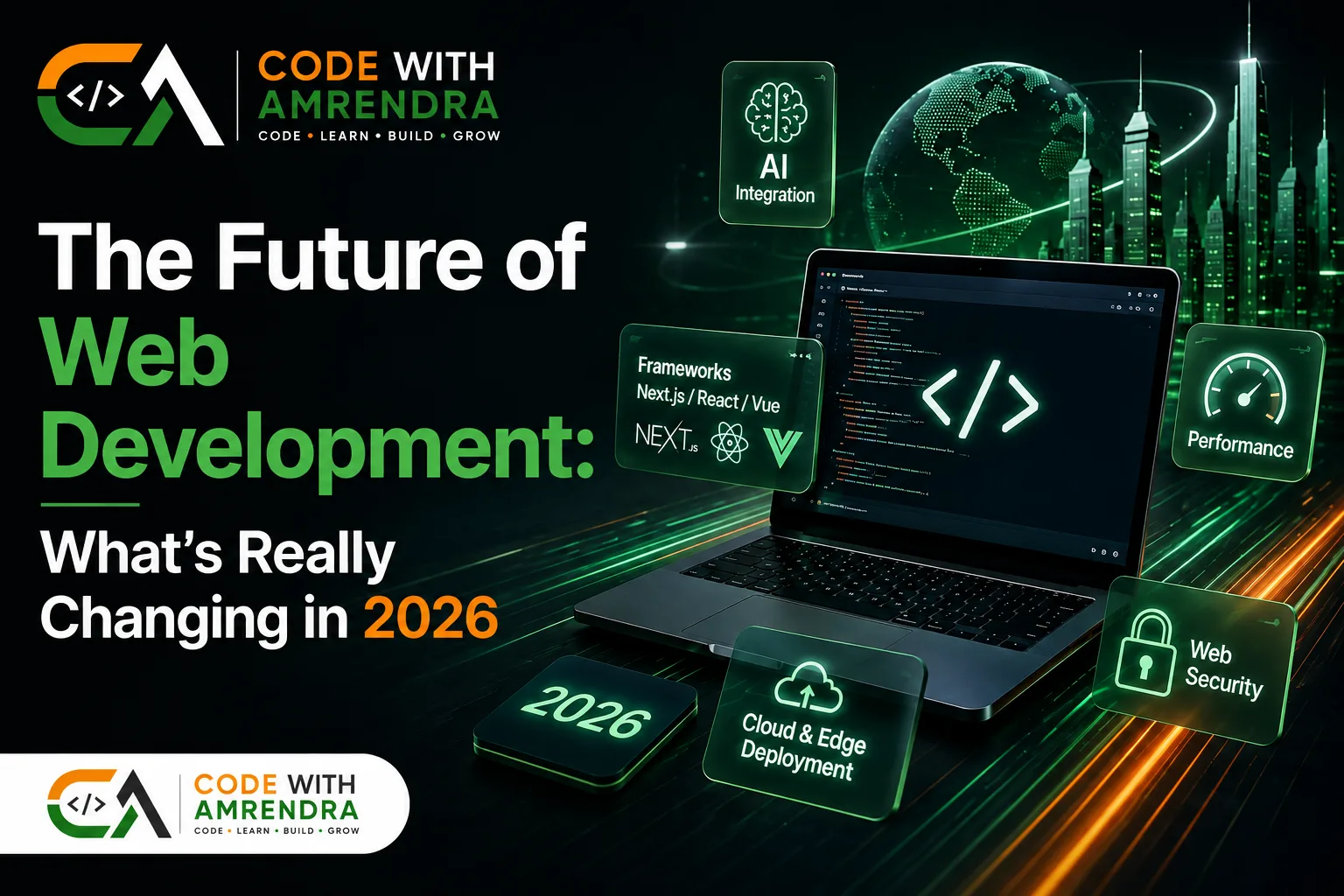
Why the Future of Web Development Is Changing
For years, web development conversations revolved around frameworks: React or Vue, monolith or microservices, traditional server or serverless. In 2026, the more useful question is different: how should teams build products when AI can generate a significant part of the implementation?
AI coding assistants, AI agents, modern cloud platforms, and automated deployment workflows are all shifting at once. But this doesn't mean engineering has disappeared, the work is moving upward. Developers spend less time writing every line manually and more time deciding what should be built, whether generated code is actually correct, and whether it will hold up under real traffic.
AI Is Changing How Code Gets Written
AI coding assistants have moved from experimental tools to a normal part of most workflows. GitHub's controlled Copilot study found developers completed a specific coding task 55% faster with it, the key word being specific. It shows AI can accelerate certain tasks, not that every developer becomes universally more productive.
More recent data explains why review still matters. Stack Overflow's 2025 Developer Survey found 84% of developers use or plan to use AI tools, while 46% said they distrust the accuracy of AI output, versus only 33% who trust it. High adoption, low trust, and that gap is exactly where developers stay valuable.
AI is excellent at producing a first draft: components, API routes, database queries, tests, boilerplate. But it can still ship incorrect assumptions, outdated APIs, or logic that only handles the happy path. The real shift isn't "AI writes the application." It's AI accelerates the first draft, while developers stay responsible for the final result, which is exactly why disciplined engineering workflows matter more now, not less.
AI Agents Are Expanding Beyond Code Generation
AI's impact isn't limited to writing source code. Agents are starting to automate parts of larger workflows: reading support requests, classifying issues, drafting responses, updating records, summarizing business data.
The industry is still early here, though. The real opportunity isn't replacing an entire SaaS product with one AI agent, it's automating specific repetitive tasks inside existing products. A business rarely needs an "AI-first application"; it usually just needs AI to remove five repetitive steps from an existing process. We covered this shift in more depth in AI agents replacing SaaS seats, and it's where practical AI automation tends to beat AI hype.
Edge Computing Is Important - But It Isn't Magic
Edge platforms execute suitable workloads closer to users, which can meaningfully cut latency for geographically spread traffic. But there's a common misconception: moving code to the edge doesn't automatically make the whole application faster.
If a request runs User → Edge → Application → Database → Application → User, and the database sits thousands of kilometers from the edge node, the database is still the bottleneck. The same applies to large JS bundles, slow third-party APIs, and uncached queries.
The right question isn't "should everything be edge-first?" It's "which parts of this application actually benefit from running closer to users?" For applications without that specific latency problem, a well-designed regional setup backed by strong cloud and DevOps practices can be simpler and just as effective.
React and Next.js: Rendering Strategy Matters More Than Hype
React remains one of the most important frontend technologies, and Next.js is the default framework for most production React apps. But the future isn't "pick one rendering strategy and use it everywhere." Modern apps increasingly mix approaches by page:
- Static/prerendered: blogs, docs, marketing pages, content that rarely changes
- Server-rendered: pages needing user-specific or frequently changing data
- Client-rendered: dashboards, visual editors, real-time interfaces
- Streaming/progressive: pages where parts can load before the full response is ready
The shift isn't "server rendering replaces client rendering," it's developers picking the strategy per experience. You can go deeper on this in our React and Next.js coverage.
Traditional Stack vs Modern Cloud Architecture
There's no universally superior architecture. A mature enterprise system, a global SaaS platform, and a small marketing site have different needs, compare based on the problem, not the label.
| Factor | Traditional Regional Architecture | Modern Cloud/Edge-Oriented Architecture |
|---|---|---|
| Infrastructure | Servers, containers, or VMs | Managed and serverless platforms |
| Deployment | CI/CD or infra-based deployment | Highly automated deployment |
| Scaling | Manually configured | Often more elastic |
| Global users | Needs CDN + regional planning | Edge/CDN capabilities built in |
| Operational control | Higher infra control | More platform abstraction |
| Complexity | Predictable for established systems | Can increase with distributed setups |
| Best fit | Complex or established systems | New products, globally distributed workloads |
Modern doesn't automatically mean better, a managed edge platform can be the wrong choice for an app that needs strong infrastructure control. Architecture should follow requirements, not trends. This decision often comes down to a bigger structural question, which we break down in microservices vs modular monolith.
The Hidden Cost of Chasing "The Future"
- Rewriting a stable app without a real problem. Migration has real cost: QA, regression testing, deployment risk, team learning time. If an app already performs well, a rewrite needs a measurable reason. If you're weighing a Next.js project, how much a Next.js website costs in 2026 puts real numbers behind that decision.
- Deploying AI-generated code without review. AI code can look convincing while containing insecure auth logic, missing validation, or outdated APIs. The fix isn't avoiding AI, it's a real pipeline: Generate → Review → Test → Security Check → Refactor → Deploy.
- Ignoring performance while adding features. Core Web Vitals measure real user experience, and a technically impressive site that loads slowly still loses users, which is why SEO and content strategy can't be separated from technical performance.
- Treating design as an afterthought. A fast app with a confusing interface is still a bad product. Performance and UX have to move together, which is why architecture and UI/UX product design should be planned as one conversation, not two.
- Using AI only for code generation. AI can also support customer support, onboarding, documentation, and internal search. A RAG chatbot connected to your own docs, for example, is often more valuable than another AI-generated component, see building a RAG chatbot for a business website.
Skills That Will Matter Most for Web Developers
The developer skillset is changing, but the answer isn't simply "learn AI." It's using AI-assisted development inside a reliable engineering process:
- AI-assisted development: knowing how to use it for implementation, debugging, and refactoring, and when not to trust the output
- System design: how components, APIs, databases, and infrastructure interact is far harder to automate than any single component
- Debugging: Stack Overflow's 2025 survey found 45% of developers said debugging AI-generated code can take more time, not less
- Security fundamentals: auth, input validation, session management, dependency risk
- Performance engineering: understanding the full request lifecycle (Browser → Network → CDN → Server → Database → Response), not just one layer
- Product thinking: asking "should we build this, and what's the simplest architecture that solves it?" rather than just "can I build this?"
Is Web Development Dying?
No. But the old way of doing it is changing. Developers who spend most of their time on repetitive boilerplate will face increasing automation. Developers who understand systems, security, performance, and product decisions will stay essential. The difference isn't whether AI can write code, it can. It's whether someone can decide what code should exist, whether it's correct, and whether it's safe to ship. That's engineering judgment, and AI hasn't eliminated that problem, it's made it more important.
The strongest teams combine AI speed with human judgment: they won't blindly trust generated code, rewrite stable apps just because a new framework trends, or move everything to the edge because it sounds modern. Want a second opinion on where your product stands? Browse our case studies or get in touch to talk through your stack.
Conclusion
AI will change how web developers work. It won't remove the need for people who understand how software should work. The developers who thrive next won't be the ones who write the most code, they'll be the ones who think clearly, use AI effectively, and validate aggressively before anything ships.